High card by suit and low card by suit refer to assigning relative values to playing cards of equal rank based on their suit. No standard ranking of suits exists for card games and not all games incorporate a suit ranking feature. When suit ranking is applied, the two most common conventions are:
- Ascending alphabetical order: clubs (lowest), followed by diamonds, hearts, and spades (highest). This ranking is used in the game of bridge.
- Alternating colors: diamonds (lowest), followed by clubs, hearts, and spades (highest). Similar to alphabetical ranking in that the two highest rankings are occupied by the same two suits (hearts and spades) in the same relative position to one another, but differing in the two lowest rankings, which while occupied by the same two suits (clubs and diamonds) have their relative position to one another swapped. This ranking is sometimes used in the Chinese card game Big Two or Choh Dai Di.
Low hands in poker can often be confusing for newcomers to the game. Indeed, even experienced players make mistakes reading the low board from time to time. The two key things to remember are: 1. Your lowest five cards count, but these cards must all be different ranks. (Paired cards only qualify as one low card, not two!) 2. The following details the various Poker hands from the highest-ranking to lowest, along with the odds of catching such a hand: Royal straight flush: The top five cards (A-K-Q-J-10) in one of the four suits. Odds: 650,000 to 1. Straight flush: Any sequence of five cards from the same suit (such as.
Poker[edit]

Most poker games do not rank suits; the ace of clubs is just as good as the ace of spades. However, small issues (such as deciding who deals first) are sometimes resolved by dealing one card to each player. If two players draw cards of the same rank, one way to break the tie is to use an arbitrary hierarchy of suits. The order of suit rank differs by location; for example, the ranking most commonly used in the United States is not the one typically used in Italy.
Cards are always compared by rank first, and only then by suit. For example, using the 'reverse alphabetical order' ranking, the ace of clubs ranks higher than any king, but lower than the ace of diamonds. High card by suit is used to break ties between poker hands as a regional variance,[1] but more commonly is used in the following situations, as well as various others, based upon the circumstances of the particular game:
- Randomly selecting a player or players.
- To randomly select a player to deal, to choose the game, to move to another table, or for other reasons, deal each player one card and the player with high card by suit is selected. Multiple players can be selected this way.
- Assigning the bring-in.
- In games such as Seven-card stud, where the player with the lowest-ranking face-up card is required to open the first betting round for a minimal amount, ties can be broken by suit. In such low stud games as razz, the player with the highest-ranking upcard must post the fractional bet.
Poker Hands Ranked By Odds
- Awarding odd chips in a split pot.
- In High-low split games, or when two players' hands tie, the pot must be split evenly between them. When there is an odd amount of money in the pot that can't be split evenly, the odd low-denomination chip can be given to the player whose hand contains the high card by suit. (This solution is not necessary in games with blinds, in which case the odd chip between high and low is awarded to the high hand, and the odd chip between a split high or split low is awarded to the first player following the dealer button.)

- Breaking ties in a chip race
- During poker tournaments, a chip race is used to 'color up' large numbers of smaller-denomination chips, and a modified deal is used to assign leftover chips. Ties in the deal are broken by suit.
Contract bridge[edit]
In bridge, suit rank during the bidding phase of the game is by ascending alphabetical order.
During the play of the cards, the trump suit is superior to all other suits and the other suits are of equal rank to each other. If there is no trump suit, all suits are of equal rank.
References[edit]
- ^'Rules of Card Games: Poker Hand Ranking'. www.pagat.com. Archived from the original on 28 May 2010. Retrieved 24 April 2018.
External links[edit]
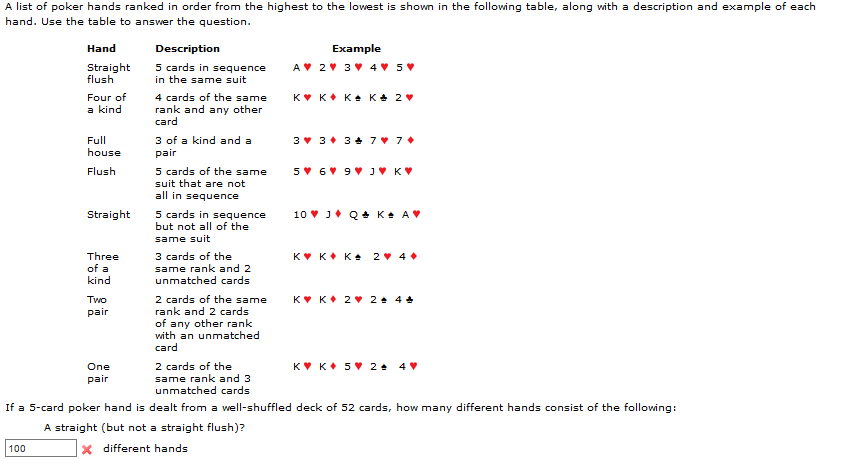
Poker may be the best-known card game, and if you’re going to play, you need to know how the hands rank. The following details the various Poker hands from the highest-ranking to lowest, along with the odds of catching such a hand:
Royal straight flush: The top five cards (A-K-Q-J-10) in one of the four suits. Odds: 650,000 to 1.
Straight flush: Any sequence of five cards from the same suit (such as the 2-3-4-5-6 of clubs). If two players have straight flushes on the same hand, the higher sequence outranks the lower one. Odds: 75,000 to 1.
Four of a kind: Four of any one card; the fifth card in the hand can be anything. If two players have four of a kind at the same time, the rank of the four cards determines the better hand. If two players have equal ranked quads, the rank of the fifth card determines who wins. Odds: 4,150 to 1.
Full house: Three of a kind matched with a pair — for example, three 10s and two 9s. If two players both have a full house, the higher three of a kind determines the better hand. Odds: 700 to 1.
Flush: Five cards of the same suit, no sequence required. When two players have flushes, the highest card in each flush determines the better hand; if the top cards are the same, you look at the second card, and so on. Odds: 500 to 1.
Straight: Five cards of consecutive rank (in numerical sequence) in any suit. If two players have straights, the top card of the straight determines the winner. Odds: 250 to 1.
Three of a kind: Also knows as triplets, trips, or a set, this hand consists of three cards of the same numeric value, together with two unmatched cards. The higher-ranking three of a kind wins. Odds: 47 to 1.
Two pair: Four cards in two pairs with an unmatched fifth card. Ties are broken by the value of the top pair, followed by the value of the second pair, and finally by the spare card. Odds: 20 to 1.
One pair: One pair with three unmatched cards is the second-lowest hand. The rank of the pair, followed by the unmatched cards, splits the tie. Odds: 2 to 5.
High card: The weakest hand, high card means you have five unmatched cards. The top card in the hand determines the better collection. If two hands tie, such as two hands with ace-high, you move to the second card, and so on. Odds: 1 to 1.